By Amedwork Ferhiwot
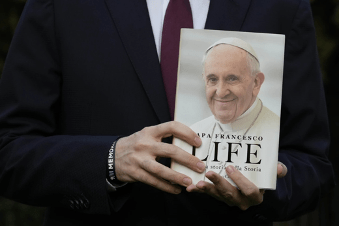
In his upcoming book, remarkable literary endeavour, Pope Francis has captured his autobiography titled “Life, My Story Through History.” This captivating book, co-authored with Italian journalist Fabio Marchese Ragona, offers a unique perspective on the Pope’s life, beliefs, and the global events that have shaped our world. The book sheds light on key moments in the Pope’s life and their intersection with world events.
Pope Francis addresses the topic of resignation, emphasizing that it remains a distant hypothesis. While he is not currently considering stepping down, he envisions a future where he would be called “Bishop Emeritus of Rome” rather than “Pope Emeritus.” Pope Francis prefers to be known as “Bishop Emeritus of Rome” rather than “Pope Emeritus” if he were to resign. His envisioned scenario involves living in the Basilica of St. Mary Major, continuing pastoral duties, and administering communion to the sick. Pope highlights that resigning is a distant assumption due to the absence of serious reasons. “I believe the pope’s ministry is ad vitam, for life, and I therefore see no justification for giving it up.” He added that the possibility remains remote since the Pope “is in good health and, God willing, there are many projects still to be realized.
The book delves into Argentina’s hard history during the dictatorship era. The book spans over 300 pages and covers all aspects of Pope Francis’s life, from his relationship with his family, especially with his grandparents, their emigration to Argentina in 1929, a “little derailment” during his seminary period, and World War II with its dramatic atomic epilogue.
The Pope condemns the use of atomic energy for war purposes, considering it a crime against humanity. His unwavering commitment to peace shines through as he questions the paradox of developing new weapons while claiming to champion peace. Pope Francis clarifies that talking about the poor does not make one a communist. Caring for the vulnerable aligns with pure Christianity, not necessarily communism. His words resonate with the essence of Christian compassion and social responsibility and he continued the book with his unwavering advocacy of human life, “from conception to death,” declaring that abortion “is murder,” carried out by “hired killers, hitmen!” and denouncing surrogacy as “inhumane.”
Pope Francis discusses his relationship with Pope Benedict XVI and touches on important topics such as the protection of creation and the inclusion of marginalized groups in the Church. He emphasizes the need for unity and calls on young people to take action to save the planet
In this heartfelt memoir, the author chronicles their life against the backdrop of humanity’s defining moments. Through war, genocide, and religious strife, the author’s voice echoes, urging the younger generation to learn from history’s scars. As we age, let us open the book of memories, discerning the toxic from the good, and embracing the blessings bestowed upon us.
AP photo (Gregorio Borgia)
 Acta Diurna