Frederick Douglas Waako
The US Catholic Bishop’s appeal to reject the proposed over-the-counter use of the progestin only “mini-pill” contraceptive hit a major snug as prescription free birth control pills will be available across the US later this month.
According to France 24, over-the-counter (OTC) birth control has long been backed by major medical organizations as a way to reduce barriers to contraception access, with almost half of the more than 6.1 million pregnancies in the US each year unintended.
“We champion the right of women and people to determine their own sexual health journey and the availability of Opill over-the-counter is truly a historic moment of which our entire organization can be proud,” said Triona Schmelter the Perrigo Executive Vice President.
Opill, which was cleared last year by the Food and Drug Administration agency for sale without prescription, is known as a “mini – pill” because it contains progestin only. It works by thickening mucus in the cervix to stop sperm reaching an egg according to the Wall Street Journal. The progestin only contraceptive, sometimes called the “mini-pill,” was proposed for over-the-counter use by its France-based manufacturer, Laboratoire HRA Pharma.
However, according to the National Catholic Register, Bishop Robert Barron chairman of the US Catholic Bishop’s (USCCB) Committee on Laity, Marriage, Family Life and Youth had earlier on cautioned, “It is concerning that the FDA has a recommendation before it to approve over-the-counter hormonal contraception when there is strong evidence of the many harmful risks to women’s health. I urge the FDA to reject this recommendation because fertility is a gift not a disease”
“Contraceptives exist to suppress the healthy functions of human reproduction. The mounting evidence of the many harmful side effects of hormonal contraceptives demonstrates that they are not good medicine,” the statement from the US Catholic Bishops read
To allow hormonal contraception access without medical supervision, Bishop Barron further said is “directly opposed to the Hippocratic Oath that guides physicians to first ‘do no harm.”
On 14 November, 2022, in a letter submitted to the FDA advisory panel, the USCCB joined the National Catholic Bioethics Center, the Catholic Medical Association, and the National Association of Catholic Nurses, who represent thousands of health-care providers and medical ethicists, to oppose allowing over-the-counter use of Opill.
“The failure rate of the minipill is higher than that of other hormonal contraceptive methods and will result in many unintended pregnancies, leading to potentially more pregnancies, leading to potentially more abortions,” the letter said.
According to the National Catholic Register the letter warned of serious harm to teens who will have access to the drug without parental notification. It cited the potential for negative side effects, such as organ failure, cardiovascular disease or neurological issues. The hormonal contraceptive may cause abnormal bleeding, ovarian cysts and depression. Prescription use, the letter added, would allow the oversight from health-care professionals that is necessary to monitor side effects.
However, according to Nbc news, experts at an FDA advisory committee meeting last year said that an over-the-counter pill would be especially important for teenagers, who often have barriers to seeing a doctor or just have not seen an OB-GYN yet. Opill was found to be 93% effective in preventing pregnancy with typical use, according to a study presented at the committee meeting, similar to prescription birth control pills. The pill must be taken at the same time every day or there is the risk of an un intended pregnancy.
In its approval, the FDA noted that side effects such as irregular bleeding may require seeing a doctor.
Meanwhile, this comes at a time when the fight over abortion access is still taking place in many courtrooms in different states in the US, where advocates have sued to block bans and restrictions while other states have moved to expand access to abortions by adding legal protections.
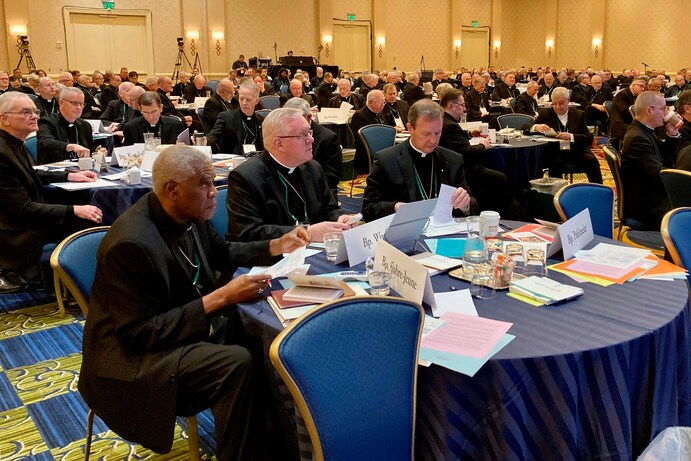
Photo Credit: Peter Smith/AP – The U.S Conference of Catholic Bishops gathered for a meeting in Baltimore.
 Acta Diurna