Kiran Paul
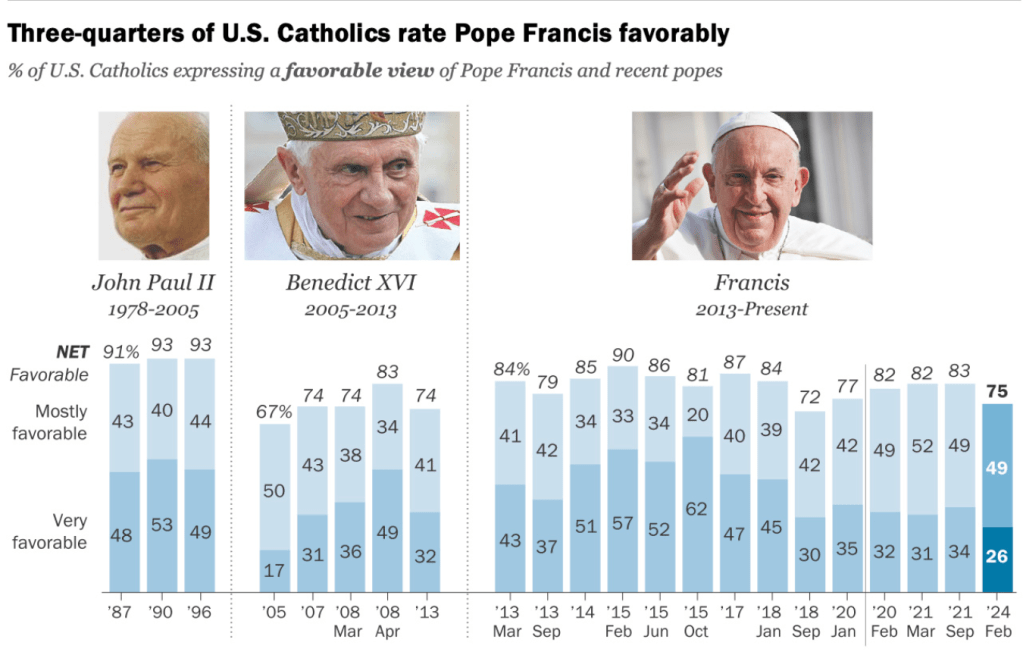
A recent survey conducted by the Pew Research Center has revealed a significant increase in polarization among U.S. Catholics regarding their opinions on Pope Francis, highlighting a growing divide within the community. The findings shed light on divergent viewpoints among Catholic Democrats and Republicans, particularly concerning social and theological issues.
According to the survey, while a substantial majority of U.S. Catholics still hold a favourable view of Pope Francis, partisan affiliations strongly shape these perceptions. Approximately 75% of all U.S. Catholics maintain a positive outlook toward the pontiff. However, when examined through a political lens, a stark contrast emerges nearly 89% of Catholic Democrats or those leaning Democratic express favourable views, compared to just under 63% of Catholic Republicans or Republican-leaning individuals. Significantly, the favourability ratings among Republican-leaning Catholics have experienced a decline, marking the largest partisan gap in approval of Pope Francis since the beginning of his papacy.
The survey suggests that recent events and controversies may have influenced Catholics’ perceptions of Pope Francis. Notably, the second-lowest favourability rating coincided with a period shortly after Archbishop Carlo Maria Viganò made allegations against Francis regarding his handling of Cardinal Theodore McCarrick’s misconduct. This context underscores the impact of external factors on public opinion regarding the pontiff. Moreover, the survey highlights differing opinions regarding Pope Francis’s role in steering the direction of the Catholic Church.
Catholics who viewed Pope Francis unfavourably were more likely than those who viewed him favourably to say he represented a major change in direction for the church. Around 54% of Catholics with unfavourable views held that belief, compared to 41% of those with favourable views, according to America Magazine. Before last October’s Synod of Bishops, Pope Francis prayed for the assembly to be a place where the Holy Spirit would “purify the church” from “polarization.” The October assembly followed a multiyear global consultation of the Catholic faithful, a process that church reformers hoped and traditionalists feared would lead to sweeping changes in the church, as reported by RNS.
Beyond attitudes toward Pope Francis, the survey also gauges U.S. Catholics’ support for various reform measures within the Church. Interestingly, while a majority of Catholics support reforms, there are discrepancies based on religious observance. Weekly Mass attendees exhibit lower rates of support for certain reforms compared to less frequent attendees. Specifically, the survey indicates strong support among U.S. Catholics for allowing married priests, with 69% expressing approval. However, this support diminishes slightly among those who attend Mass weekly or more frequently, signalling potential divisions in opinion within the Catholic community regarding traditional aspects of priesthood.
 Acta Diurna