Alfi D’Cruz
Pope Francis has captivated the world not only through his reforms and leadership but also through his profound spirituality. Rooted in the Ignatian tradition of the Jesuits, his spirituality emphasizes mercy, simplicity, and the importance of encountering God in everyday life.
Pope Francis, born Jorge Mario Bergoglio on December 17, 1936, in Buenos Aires, Argentina, has become one of the most influential and transformative figures in the Catholic Church. Elected as the 266th Pope on March 13, 2013, he is the first Jesuit pope. His papacy has been marked by a commitment to social justice, environmental stewardship, and a more inclusive Church, earning him widespread admiration and occasional controversy.
Jorge Mario Bergoglio was born to Italian immigrant parents in Argentina. He worked as a chemical technician before entering the Society of Jesus (Jesuits) in 1958. He was ordained a priest in 1969 and served as the Provincial Superior of the Jesuits in Argentina from 1973 to 1979. Bergoglio’s leadership during Argentina’s military dictatorship (1976–1983) has been both praised and criticized, with some accusing him of not doing enough to oppose the regime, while others highlight his efforts to protect individuals from persecution[MOU1] .
In 1998, he was appointed Archbishop of Buenos Aires and later became a cardinal in 2001. Known for his simplicity, Bergoglio lived simply, often taking public transportation and cooking his own meals. His modest lifestyle and focus on the poor resonated deeply with Catholics worldwide, setting the stage for his election as pope in 2013 following the resignation of Pope Benedict XVI.
When Pope Francis was asked in an interview from where does his spirituality comes he boldly responded by saying it comes from Vatican II. As the first Jesuit pope, Francis’s spirituality is deeply influenced by the teachings of St. Ignatius of Loyola, the founder of the Society of Jesus. Ignatian spirituality emphasizes discernment, a process of prayerful reflection to understand God’s will. This is evident in Francis’s leadership style, which is marked by careful listening and a willingness to adapt to the signs of the times. Francis’s spirituality of encounter also extends to the natural world. In his encyclical Laudato Si’, he calls for an “ecological conversion,” urging humanity to see the Earth as a gift from God and to care for it as a common home. This holistic vision reflects his belief that spirituality is not separate from the material world but is deeply intertwined with it. From choosing the name Francis, after St. Francis of Assisi, to his simple lifestyle and love towards environment.
Mercy is the cornerstone of Pope Francis’s spirituality. He has repeatedly stated that “mercy is the Lord’s most powerful message,” and his papacy has been defined by this theme. In 2015, he declared an extraordinary Jubilee Year of Mercy, emphasizing that God’s love and forgiveness are available to all, especially those who feel excluded or unworthy.
A key aspect of Pope Francis’s spirituality is the importance of encounter. He believes that true faith is not abstract but is lived in relationship with others. This is evident in his efforts to build bridges with people of other faiths, cultures, and ideologies. His meetings with Orthodox Patriarch Bartholomew I, Grand Imam Ahmed al-Tayeb, and even political leaders like former U.S. President Barack Obama and Cuban leader Raúl Castro demonstrate his commitment to dialogue and unity. Just like St. Francis of Assisi took a courage to have dialogue with the sultan. In his encyclical Fratelli Tutti Pope Francis speaks about St. Francis by saying that ‘Francis did not wage war of words aimed at imposing doctrines; he simply spread the love of God.’
His spirituality is not just a personal devotion but a call to action. By embodying the values he preaches, Pope Francis has become a living example of what it means to live a faith that is both deeply rooted and radically inclusive. Pope Francis’s papacy represents a bold and compassionate vision for the Catholic Church in the 21st century. By prioritizing the marginalized, advocating for environmental justice, and fostering dialogue, he has challenged both the Church and the world to embrace a more inclusive and equitable future. While his tenure has not been without controversy, his impact on the global stage is undeniable. As he continues to lead, Pope Francis remains a beacon of hope and a testament to the transformative power of faith and humility.
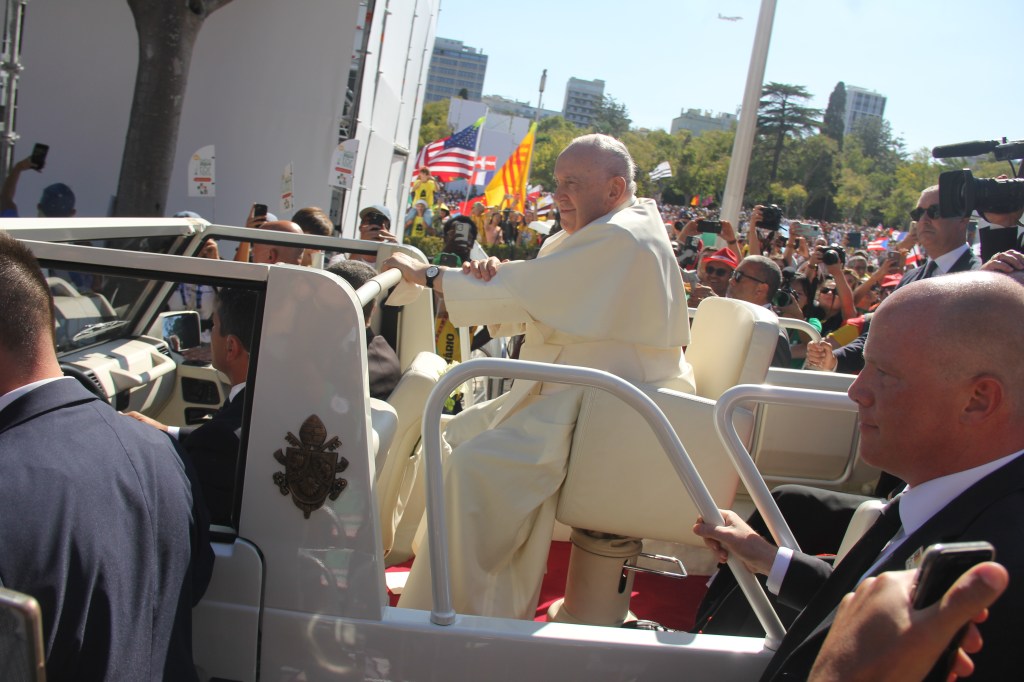
Photo credit : Pope Francis during world Youth Day (2023) by Alfi Alex D’Cruz.
 Acta Diurna