Douglas Milton Logu Soosaithasan
In preparation for the Jubilee Year of the Church, celebrated under the theme of the Pilgrimage of Faith, the Italian government has undertaken numerous renovation projects to restore and highlight the beauty of Rome’s ancient monuments. Among these initiatives is the restoration of the historic pharmacy, the “Spezieria di Santa Maria della Scala,” which has long attracted tourists and enthusiasts interested in exploring the traditional practices and remedies of herbal medicine.
Closed to the public since October 1, 2024, the pharmacy remains inaccessible during its restoration, which is being meticulously coordinated by the Special Superintendence of Archaeology, Fine Arts, and Landscape of Rome.
The Pharmacy of the Popes
The ancient pharmacy, located in the Trastevere district, traces its origins to the sixteenth century, founded by the Order of the Discalced Carmelites. For centuries, it served the public and gained immense prestige, attracting notable figures such as cardinals, princes, and even popes. This prominence earned it the nickname “pharmacy of the popes” and established its legacy as not only the oldest pharmacy in Rome but potentially all of Italy.
Part of the building complex of the oldest monastery of the Discalced Carmelites, dating back to the 15th century, the pharmacy was diligently operated and maintained by the friars residing within the monastery. Its historical significance and enduring legacy make it a remarkable testament to the Carmelite order’s contributions.
Permission Granted by Pope Alexander VI
Permission to open apothecaries in the monastery of this religious order was given by Pope Alexander VI. In Rome there were two conventual apothecaries. The first of these was at Santa Maria della Scala and the second was at Santa Maria della Vittoria. The spezieria at Santa Maria della Scala was opened under the name Spezieria de’ PP. Carmelitani Scalzi della Scala di Roma. Initially, its remedies were for internal use and consumption by monastery’s friars and it was only from 17th century onwards that the monastery was able to dispense them to the general public.
Historical records from this monastery reveal that, until 1954, the pharmacy actively prepared and sold medicines to cater to the medical needs of the local community. This longstanding practice highlights its vital role in providing healthcare services to the people over the centuries.
A Hub for Teaching and Healing in Baroque Europe
We know that it also served as a centre for teaching about the methods of preparing medicinal herbs by Friar Basil in the eighteenth century. What helped this Roman spezieria to become well positioned and well thought of by most powerful and distinguished classes of baroque Europe were its herbal remedies against the plague and other epidemics prepared there by Friar Basil.
Treasures Within the Spezieria
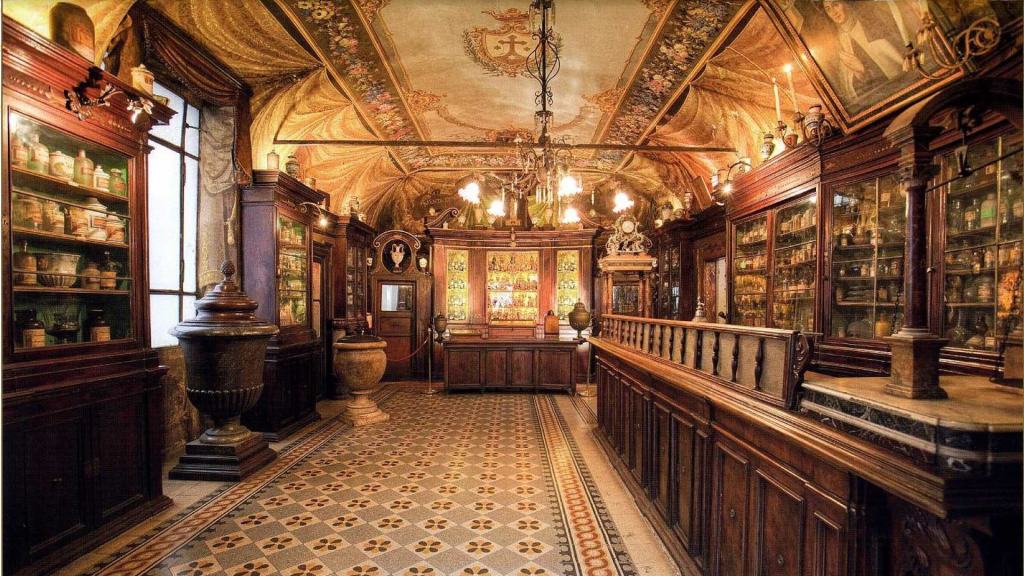
Inside this ancient pharmacy, the “Spezieria di Santa Maria della Scala,” visitors would find a treasure trove of valuable historical materials. To enter the spezieria from the street, one climbs a staircase that leads to the sale room, where the main vitrine contains the most ancient receptacles and the drugs. We can see the mural painting that decorates the sales room ceiling. From sales room two more rooms are accessed. One is the galenic laboratory, on the left, where the infrastructure and materials used by the apothecaries to conduct their practice are preserved. The other, on the right, is the back room, which contains a large wooden cupboard where the boxes used to preserve the raw materials for preparing compound drugs are stored. The doors of this cupboard are decorated with the images of Hippocrates, Galen, Dioscorides, Paracelsus, Avicenna and Mesue and other medical and pharmaceutical scientists.
Challenges and Careful Restoration Work
According to Rev. Fr. Ambrose Dsouza, Rector of the Discalced Carmelites of Santa Maria della Scala, despite a notice displayed at the entrance stating that the ancient pharmacy is temporarily closed for renovation, many tourists and Jubilee pilgrims remain unaware and continue to contact the community via phone and email to make reservations to visit it. Rev.Fr. Mark Furtado, a friar from the same community who serves as a guide and interpreter for visitors to the pharmacy, shared that the boxes of raw medicinal materials and other valuable items from the pharmacy have been safely transferred to a secure location by the Department of Archaeology. He further explained that the renovation work requires extreme precision and care to preserve the ancient glory of the pharmacy and safeguard its murals. As a result, it is currently impossible to predict how long the project will take or when the pharmacy will reopen to the public for visits.
A modern pharmacy now operates on the lower floor of the building complex, symbolizing the seamless continuity of the ancient pharmacy’s legacy. This coexistence vividly illustrates how the present is deeply rooted in the past, with modern innovations flourishing on the enduring foundation of history and tradition. This blend of old and new showcases the remarkable journey of the pharmacy, bridging centuries of knowledge and service.
 Acta Diurna