Genesis Labana
Two days after his election, Pope Leo XIV gathered the College of Cardinals at the Vatican for his first formal address. In this meeting, he laid out the focus of his papacy and explained his choice of the name “Leo XIV.”
Drawing a parallel to today, Pope Leo XIV emphasized that the Church now faces new challenges brought about by the digital revolution and the rise of artificial intelligence. He underscored the enduring relevance of Catholic social teaching in addressing these developments, particularly in the defense of human dignity, justice, and labor.
This address signaled the priorities of his pontificate: a continuity with his predecessors, especially Pope Francis, and a renewed commitment to confronting contemporary social issues through the lens of Catholic tradition.
As the first Augustinian and American pope, with ancestral roots in Italy, France, Spain, Haiti, and African-American heritage, Pope Leo XIV did not elaborate further on his choice of name.
Some observers also linked his choice of name to Pope Leo the Great (440–461), who famously met Attila the Hun and persuaded him to spare the city of Rome.
However, those familiar with Augustinian history quickly recognized additional layers of meaning, especially given his deep connection to the Order of Saint Augustine, which he once led as Prior General for 12 years.
A Historical Link with Pope Leo XIII
Beyond the influence of Rerum Novarum, there are deeper reasons why Cardinal Robert Prevost may have chosen the name Leo XIV. Pope Leo XIII (Gioacchino Pecci), remembered as a champion of Catholic social teaching, was also a great friend and benefactor of the Augustinian Order.
According to Fr. Allan Fitzgerald, OSA, “Pope Leo XIII was a great friend of the Augustinian Order,” while Fr. Michael Endicott, OSA, noted that the Order “ranked him high among its benefactors.”
In the 1880s, the Augustinian presence in Italy was waning due to political upheaval and the confiscation of religious properties. Pope Leo XIII’s interventions helped to revive the Order, prompting the Augustinians to say, “The Pope in 1256 helped the birth of the Order, and Leo XIII helped save it from dying.”
Some of his notable contributions include:
-Restoration Projects – He rebuilt the ancient church and convent in his hometown of Carpineto and provided it with ongoing financial support.
-Leadership Support – He personally appointed Anthony Pacifico Neno, OSA, an US born Italian friar, as Prior General, paving the way for renewal.
-Educational Infrastructure – He approved the acquisition of the lot near St. Peter’s Square for the construction of the Augustinian General Curia and Saint Monica’s International College, located at Via Paolo VI, No. 25.
-Ecclesiastical Recognition – He appointed three Augustinian cardinals, including Sebastian Martinelli, OSA, who served as Apostolic Delegate to the United States from 1896 to 1902.
-Pastoral Assignments – He entrusted the Order with the parish of Castel Gandolfo in 1892 (later replaced by the Vatican parish of Saint Anne in 1929).
-Canonizations – He canonized two Augustinian saints: Saint Clare of Montefalco (1881) and Saint Rita of Cascia (1900), and beatified Alonso de Orozco, now also a saint.
-Custody of Augustine’s Remains – He returned the Church of Saint Peter in Ciel d’Oro in Pavia to the Augustinians and allowed them to once again care for the relics of Saint Augustine.
A Pilgrimage to Genazzano
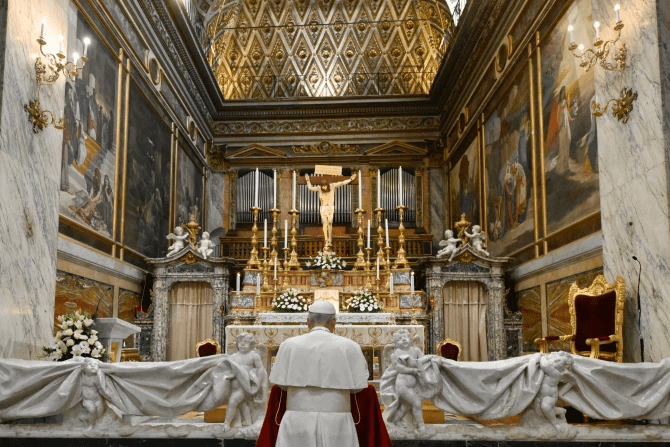
On May 10, 2025, just two days after his election, Pope Leo XIV made an unannounced pilgrimage to Genazzano, home to the Augustinian Marian shrine of Our Mother of Good Counsel. There, he prayed before the ancient image of the Virgin Mary and joined the faithful in reciting the prayer of Pope Saint John Paul II to the Madonna.
“I wanted so much to come here in these first days of the new ministry that the Church has entrusted to me,” he said, “to carry out this mission as the successor of Peter.”
His predecessor, Pope Leo XIII, also held a strong devotion to Our Mother of Good Counsel, adding her title to the Litany of Loreto on April 22, 1903. He also enlarged the convent in Genazzano. This shared Marian devotion stresses the spiritual continuity between Leo XIII and Leo XIV.
The in-depth historical connection between Pope Leo XIII and Pope Leo XIV goes beyond a shared name. It reflects a shared vision of a Church committed to social justice, rooted in Augustinian values, and devoted to peace and pastoral renewal.
 Acta Diurna